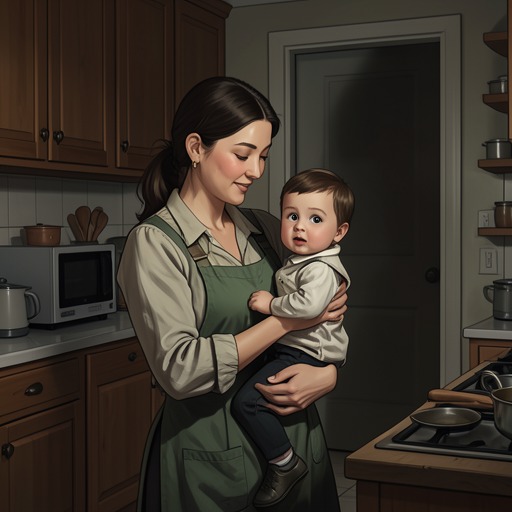
The close mother-son bond between Grace and Billy Poe
American RustGrace Poe’s relationship with Billy Poe is the emotional center of her response to his imprisonment: she experiences his absence as both a public disgrace and a private bereavement, yet remains convinced that protecting him is part of being his mother. Her loyalty is not presented as uncomplicated certainty. As she defends Billy’s account of self-defense, Grace confronts the possibility that maternal love may lead her to accept a moral choice she would otherwise condemn.
Absence and public judgment
Billy has been gone only three days, but Grace finds that his arrest has already become common knowledge in town. At work, she hears people discussing the way he played football and how hard he hit other players. Their talk turns his capacity for violence into a judgment of his character, leaving Grace to keep her eyes down and feed fabric through the sewing machine in even stitches. The careful repetition of her work contrasts with the public conversation she cannot stop hearing, and offers no answer to it.
The scrutiny follows her beyond work. On the way home from her job, Grace encounters Nessie Campbell at Giant Eagle; even Nessie’s apparent interest in frozen fish seems to Grace a pretense. The scene makes Billy’s absence feel socially crowded: Grace has little privacy from other people’s knowledge of the case, even in an ordinary errand. Her isolation is sharpened by the fact that the town’s discussion concerns the violence of her son, while she is left to bear its consequences in silence.
The son in the empty house
On April 15, Grace tries to turn to the tax forms she had started the previous week, but the household feels cold and she cannot concentrate. The taxes become a measure of how thoroughly Billy’s situation has displaced ordinary concerns. She goes outside instead, looking over green rolling hills toward a large barn. In that quiet, she thinks that if Bud Harris had a son, Billy would not be in jail. She remembers Harris as someone who had looked out for Billy despite owing Grace nothing, and wonders whether she had taken that help for granted.
The thought brings her own past relationship with Virgil into view. For fifteen years, fear of losing him had helped keep her bound to him; now that she has stood up to him, she can recognize the hold that fear once had. But the comparison does not ease her concern for Billy. Grace imagines that Harris’s son would not be in prison, and the thought turns gratitude toward Harris into a painful counterfactual about what her own son lacks. She also questions the rumors that Harris has killed people, first dismissing them and then considering that he might be capable of killing if he believed it necessary. Her worry for Billy thus draws her toward a protector whose capacity for violence she cannot confidently dismiss.
Memory, guilt, and self-defense
After a nearly sleepless night, Grace calls in sick and goes into Billy’s room. A hole in the door, covered with masking tape, recalls one of his tantrums, though she cannot remember what caused it. Inside, sunlight catches old dust; the room feels like a tomb. Grace lies on his bed, where his smell remains, and sees together the child she raised and the man he has become. His room holds the unfinished accumulation of a life: sagging posters, clothes and shoes, hunting magazines, school papers, and a curtain rod he never put back up.
The objects also make the absence difficult to accept. Billy’s closet is a tall pile of belongings barely held behind its door, and Grace thinks it will have to be thrown away because he is never coming back. She then lifts a beer bottle from his dresser, wanting to throw it through the window and smash the room, but there is no one there to witness or hear her. Her distress remains private, as the public talk about Billy continues outside the house.
Billy’s hunting bow and Winchester Model 94 rifle carry a different charge. Grace knows that he took care of them, waxing the bowstring and oiling the rifle, and remembers that he kept them on wooden pegs he had made himself. She lifts the rifle and cocks the hammer without checking whether it is loaded. The possibility that it may be loaded becomes, in her thoughts, a game in which she could avoid responsibility if it fired. The moment shows how Billy’s absence has left Grace in a dangerous state of despair; it does not resolve what she will do.
A mother’s defense
Grace insists to herself that she is a good person who has always done the right thing. She remembers her work at the women’s shelter and the people she has helped, then sets that self-understanding against her defense of Billy. She believes he acted in self-defense: she had seen his neck and imagines that one of the men involved, perhaps the man who died, had tried to cut his throat. Yet she recognizes that this is not how others are describing the case, and fears that Billy will lose his life in prison for nothing.
Her reasoning narrows around the choice between her son and the dead man, whom she thinks of as a homeless stranger. Grace knows that this is not how she is supposed to think, but concludes that there is no question: she chooses Billy. The conflict is not simply between a mother and a hostile town; it is between her general belief in doing right and the particular claim of her son’s survival. Her love does not remove that conflict. It makes her acknowledge it and act within it.
After taking a long bath with sandalwood bubble soap saved from a gift by the women at the shelter, Grace calls Bud Harris. He promises to come over. The call follows her thought that Harris can find the man connected to Billy’s case, linking her maternal loyalty to the possibility of intervention. When Harris arrives, Grace is sitting on the couch as if surprised to see him and says she did not hear him come up. The scene ends before his visit reveals what help he will provide, leaving the bond’s decisive feature intact: Billy is absent, but Grace’s choices continue to organize themselves around protecting him.